Marius
Les MisérablesMarius is the estranged son of Georges Pontmercy, an officer of the Empire, and the grandson of M. Gillenormand, a royalist who raises him according to principles hostile to his father’s. His story joins political inheritance to private loss: Marius grows up without understanding the father whose name and example he will later receive, then enters adulthood through bereavement, poverty, and the sudden sight of a young woman in the Luxembourg Gardens.
Family and Political Inheritance
Marius’s parents come from opposing social and political worlds. His father, Georges Pontmercy, is a hero of the Empire; his mother belongs to a prominent bourgeois family. Napoléon Ier made Georges a colonel and a baron, but Louis XVIII refused to recognize those titles. After Marius’s mother died, her father, M. Gillenormand, took the boy from Georges and brought him up according to his own principles, which were royalist and hostile to his son-in-law’s convictions. Marius’s childhood is therefore shaped by a political disagreement he has not chosen and a paternal relationship he has little opportunity to know.
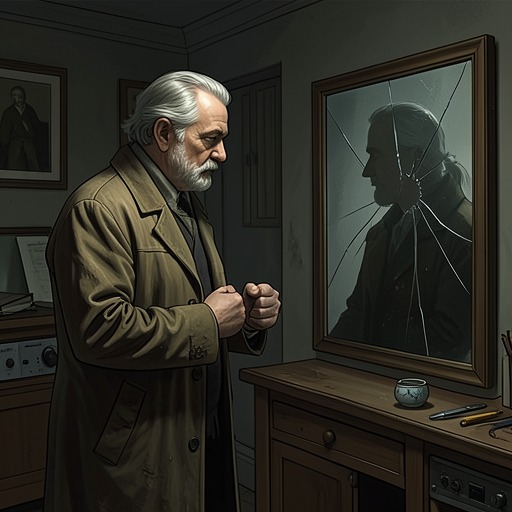
That separation determines the terms on which Marius later encounters his father’s legacy. In 1827, when he has just turned seventeen, Marius is sent to Vernon. He arrives too late to establish a relationship with Georges: his father has died, and a doctor, a priest, and a woman stand around the bereaved household while Marius feels like an outsider among them. He is conscious that his grief does not match theirs. He even lets his hat fall, aware that the gesture might make his distress appear greater, and feels ashamed of the pretence. The passage presents his estrangement not as a simple rejection of his father but as an emotional absence for which Marius knows he is, in part, unprepared.
Georges leaves no fortune. The sale of his furniture scarcely covers the funeral. What reaches Marius instead is a scrap of paper in his father’s handwriting. Georges states that Napoléon Ier made him a baron on the battlefield of Waterloo and that Marius should claim the title for which his father paid in blood. On the reverse, Georges records that a sergeant saved his life at Waterloo and asks his son to do whatever good he can for Thénardier if they meet. Marius takes the paper and keeps it, not out of religious devotion to his father, but from the powerful respect the dead command. The note gives him both a political inheritance and a personal obligation, though the evidence here shows only that he preserves the message, not what he later does with it.
Poverty and Life at Gorbeau House
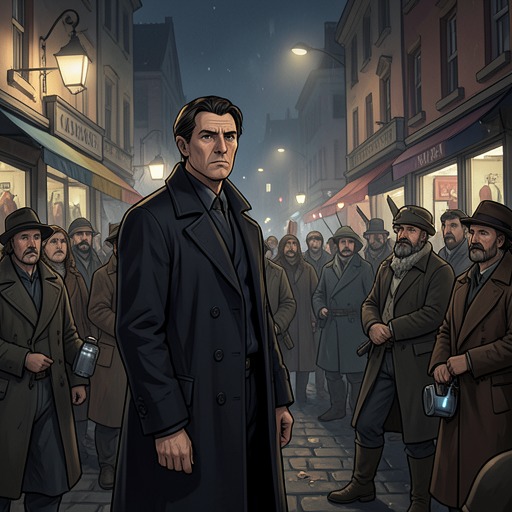
By the time the narrative finds him in Paris, Marius is living in severe poverty. The account makes deprivation concrete: days without bread, nights without sleep, evenings without a candle, a cold hearth, weeks without work, and a future without hope. His clothes are worn; his coat is patched at the elbow, his hat invites laughter, and his boots are full of holes. A landlord may close the door against him for unpaid rent, while a porter, an innkeeper, and neighbours make poverty a daily source of humiliation. Marius learns to endure not a single misfortune but a succession of material privations and affronts to dignity.
The hardship bears especially on his youth. At an age when pride and the need for love are keen, Marius feels mocked for being badly dressed and ridiculous because he is poor. The narrative contrasts the imperial pride associated with his father’s military title with the humiliating sight of the son looking down at his damaged boots. Poverty becomes an ordeal through which he must live before his inheritance can mean anything beyond a letter and a name. The passage distinguishes the effects of that ordeal: it may debase the weak, while the strong may emerge elevated. It does not yet say which outcome Marius will reach; it establishes the pressure under which his character is being formed.
His lodgings place him in immediate proximity to another impoverished household. In the Gorbeau House tenement, the Jondrette family occupies the last room at the end of the corridor, while Marius lives in the adjoining cell. The introduction locates him among the poor not as a distant observer but as a neighbour sharing the same deteriorating building. That close arrangement also brings his story into the same physical space as the Jondrette family’s, though the evidence here establishes their proximity rather than the details of their interactions.
The Luxembourg Gardens and a Changed Encounter
Marius has a habitual path in the Luxembourg Gardens, an allée associated with a man and a girl he has seen on the same bench. After an unexplained absence of nearly six months, he returns on a clear summer morning in a joyful mood. The setting is presented through his responsiveness to it: birdsong and glimpses of blue sky through the leaves seem to fill his heart. His return takes him straight to his familiar allée and to the familiar couple.
The recognition is also a reversal. The man is the same, but the girl seems no longer to be the same person. She has grown into a beautiful fifteen-year-old, at an age when the graces of childhood and womanhood briefly coexist. The description dwells on her chestnut hair with golden strands, pale complexion, lowered eyes, and long lashes; even her smile and speech are rendered as light and music. When Marius passes her, he does not see her eyes, which remain lowered. The scene’s careful attention to her changed appearance makes the interval of six months visible in a single encounter: Marius returns to a familiar place and finds that time has transformed the figure on its familiar bench. It establishes the encounter as a decisive change in how the girl is presented to him, while leaving his immediate response less explicit than the description of her appearance.
A Character Formed by Belated Knowledge
The episodes presented here give Marius two inheritances that arrive in different forms. His father’s note conveys a contested title, a memory of Waterloo, and an appeal to repay a debt of gratitude; his poverty supplies no material security with which to claim any of them. The delayed encounter with Georges also complicates filial feeling: Marius is ashamed of performing grief, yet he keeps the paper left by the man he scarcely knew. His circumstances make the gap between inherited identity and lived experience tangible, from the baronial title paid for in battle to the holes in his boots.
The Luxembourg episode introduces a different kind of change. Marius has returned to an accustomed walk and an accustomed sight, but the girl’s altered age and appearance make repetition impossible: the same bench and the same man frame a new encounter. Alongside his father’s paper, which turns the past into an obligation, this scene makes time itself an active force in Marius’s story. In the evidence presented here, he is still at the threshold of his adult life, carrying a legacy he has only begun to understand and confronting a present that has changed while he was away.